hello@synaryverse.com
In this article+
- Why Design Does the Heavy Lifting in Property Marketing
- The Marketing Materials that Actually Move Listings
- What Separates Designs that Sell from Designs that Just Look Nice
- One job per piece
- Consistency across every touchpoint
- Mobile first, always
- Honest visuals
- Hiring Real Estate Graphic Design Services vs. Doing it Yourself
Ask any agent who has stood through a quiet open house, and they'll tell you the listing didn't fail at the front door. It failed on a phone screen days earlier, when a buyer scrolled right past it.
That isn't a hunch. In the National Association of Realtors' Home Buyers and Sellers Generational Trends report, photos have topped the list of most useful website features every single year, with more than eight in ten online buyers rating them "very useful." Floor plans now sit comfortably near the top too. Buyers decide with their eyes first and read second.
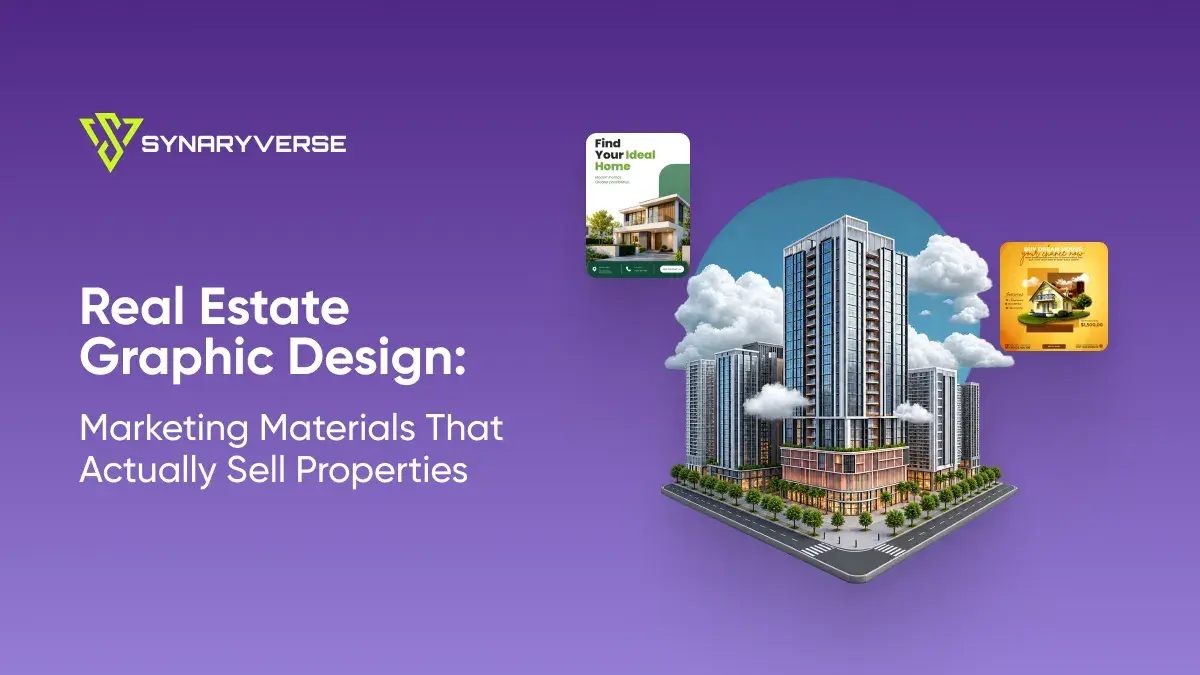
So when we talk about real estate graphic design, we're not talking about decoration. We're talking about the materials that turn a scroll into a showing. Here's what earns its place, and what's just noise.
Why Design Does the Heavy Lifting in Property Marketing
A home is an expensive, emotional purchase, and most buyers start looking alone, on their phone, late at night. Your marketing has a few seconds to do three jobs: stop the scroll, make the home feel livable, and make you look like the agent worth calling.
The data on visuals is remarkably consistent. A Redfin study across 22 markets found that professionally photographed homes sold faster and closer to list price, with homes in the $400,000 range fetching thousands more than those shot on point-and-shoot cameras. NAR's 2025 Profile of Home Staging adds that 83% of buyers' agents said staging helped buyers picture the property as their future home.
Good design is the layer that packages those photos and that "I could live here" feeling into something people remember after they close the app.
The Marketing Materials that Actually Move Listings
Not every piece pulls its weight. In the real estate projects our team has handled, these are the ones that consistently earn their cost:
Listing flyers and feature sheets. Still the workhorse at open houses. The good ones lead with one hero image, the price, and three standout features, not a wall of bullet points.
Social media graphics. "Just listed," "open house," "under contract," and "sold" posts in one consistent style. Repetition builds recognition in your farm area far more than clever one-offs. Our guide to social media graphic design covers sizing and template systems in more depth.
Floor plan graphics. Clean, branded 2D plans. When buyers rank floor plans this highly, a scanned hand sketch is a missed opportunity.
Listing presentations. The deck you bring to a seller appointment is a pitch for your commission. Tidy comps, readable charts, and a clear marketing plan win listings. This is where professional graphics design pays for itself quickly.
Brochures for luxury homes and new developments. Higher price points deserve print: heavier stock, generous white space and copy about the lifestyle and neighbourhood, not just square footage.
Signage and direct mail. Yard signs and postcards get about two seconds of attention. Big type, one message, one call to action.
What Separates Designs that Sell from Designs that Just Look Nice
One job per piece
A flyer trying to sell the home, the agent, the brokerage and a mortgage partner at once ends up selling none of them.
Consistency across every touchpoint
The same logo lockup, colours and typefaces on the sign, the Instagram post and the brochure. Over time, people recognise you before they read your name. If those basics aren't nailed down yet, start with branding and logo design.
Mobile first, always
Most of your audience sees your graphics on a screen smaller than a postcard. Test every design at phone size before it goes out.
Honest visuals
Heavy retouching that hides a cracked driveway, or virtual staging that isn't labelled, can break MLS rules and kill trust at the first showing. Ad copy and imagery also need to stay within fair housing advertising rules, which means describing the property, not the "ideal" buyer.
A clear next step. A QR code to the listing page or virtual tour, and a phone number big enough to read without squinting.
Hiring Real Estate Graphic Design Services vs. Doing it Yourself
DIY templates are fine for a quick story post. Where agents usually hit a wall is volume. Twenty listings a quarter, each needing a flyer, five social posts, a feature sheet, and a sold announcement, adds up fast, and quality slips when you're designing at midnight.
That's the point where real estate graphic design services make sense. A designer builds a template system around your brand once, then turns around each new listing kit quickly while everything stays on brand.
To get the best result from any designer, bring a proper brief: your brand guidelines, the listing photos, the three features you'd point out in person, the price, and who you think the buyer is. A tight brief means fewer revision rounds.
At Synaryverse, our design team builds listing kits, presentation decks, and brochure systems for agents and brokerages, and pairs them with AI video production and 2D & 3D animation for property walkthroughs or web design for single-property sites when a listing needs more.
Buyers judge with their eyes, and your marketing is the first viewing. Make it count.
FAQ
FAQs
What does a real estate graphic designer actually do?
+
They create the visual marketing behind listings and agent brands: flyers, feature sheets, social posts, brochures, floor plans, signage, email templates, and listing presentations, all kept consistent with your brand.
How much do real estate graphic design services cost?
+
It depends on scope. A single flyer is usually priced per piece, while agents with steady listing volume often save with a monthly package that covers a full kit per listing. Ask for a quote based on how many listings you handle each month.
Which marketing materials matter most when selling a home?
+
Start with whatever buyers see first online: photo-led listing graphics, a clean floor plan, and consistent social posts. Print flyers, brochures, and signage then reinforce that first impression in person.
How long does it take to design a listing marketing kit?
+
Building the initial template system usually takes one to two weeks. After that, each new listing kit can typically be turned around in a day or two, since only the photos and details change.
Are templates good enough, or do I need custom design?
+
Templates work for occasional posts. If you list regularly or sell at higher price points, a custom template system gives you the speed of templates with a look competitors can't copy from the same free library.