hello@synaryverse.com
In this article+
Selling a building that doesn't exist yet is a strange job. You're asking a buyer, an investor, or a planning board to commit money and trust to a set of drawings and a promise. Floor plans help. A good render helps more. But neither one lets a person stand in the kitchen at 7 a.m. and see where the light falls.
That's the gap 3D walkthrough animation fills. Below, we look at how real estate developers, agents, and architecture firms actually use these videos, where they pay off, and what to check before you hire a studio for 3D walkthrough animation services.
What a 3D Walkthrough Animation Actually Is
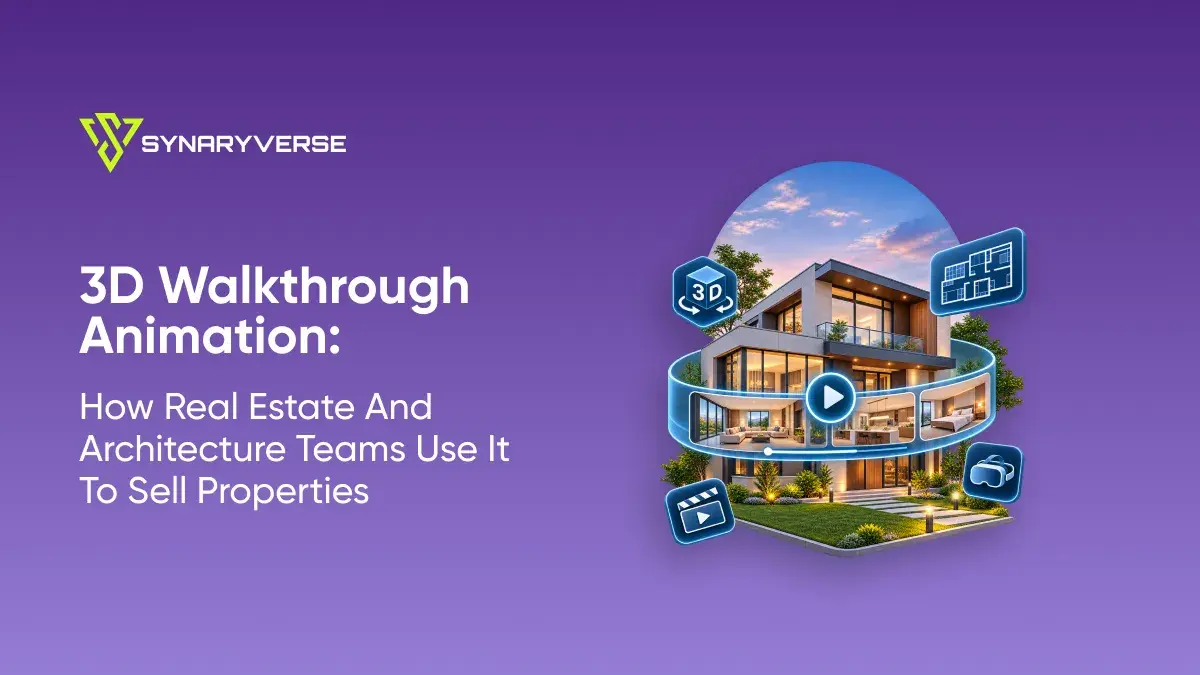
A 3D walkthrough animation is a rendered video that moves a camera through a space built from architectural data: CAD files, BIM models, or plain 2D drawings that a modeler turns into geometry. A still render is one image from one angle. An architectural animation is a sequence of frames played in order, so the viewer feels movement, scale, and flow.
It's worth separating it from two things it often gets mixed up with. A 3D virtual tour is usually interactive and click-driven, and is often captured in a finished property with a scanning camera. A flythrough is typically an aerial or exterior pass. A walkthrough stays at eye level and follows the path a real visitor would take: front door, hallway, living room, balcony. That human-height path is what makes it persuasive.
How Real Estate Teams Use Walkthroughs to Sell
For developers selling off-plan, the walkthrough often does the heavy lifting before a single foundation is poured. Buyers can't tour a show flat that hasn't been built, so the video becomes the show flat.
Demand for this kind of content isn't a guess. In NAR's 2021 Home Buyers and Sellers Generational Trends report, 58% of buyers said they wanted virtual tours on listings and 67% wanted floor plans. Yet a study of 25,000 U.S. listings reported by NAR found 94% had no real virtual tour, and many were passing off photo slideshows as one. That gap is an opening for anyone willing to do it properly.
Buyers will also act on what they see. A Rocket Mortgage survey of more than 800 buyers, covered by NAR, found three in five would be willing to buy after only a virtual tour. Prerecorded tours scored higher on satisfaction than live tours or panoramic photos.
In practice, real estate teams put walkthroughs to work in a few places:
Pre-launch campaigns, where a 30- to 60-second cut runs on social and paid ads.
Listing pages and microsites, with a longer version beside the floor plans.
Sales galleries and broker events, played on large screens so agents can pause and talk through finishes.
Overseas buyers, who may never visit before signing.
If the video will run through paid channels, plan it alongside your digital marketing strategy from day one. You'll get the cut-downs and aspect ratios you need instead of re-editing later.
How Architecture Teams Use Them
Architects use walkthroughs less as ads and more as a way to be understood. A client who struggles to read a section drawing will grasp a ceiling height in seconds once the camera moves under it.
Three uses come up again and again:
Design reviews. Walking a client through the space surfaces objections early, when a change costs a redraw rather than a change order on site.
Planning and community consultations. Showing a building in its street context, at human height, tends to settle worries that elevations alone can't.
Competition and pitch entries. A short, well-directed film can carry a concept further than a stack of presentation boards.
Real-time engines have changed the pace of this work. Tools such as Unreal Engine let studios swap materials and adjust lighting live during a review, instead of waiting days for a fresh render. For iterative design, that matters.
What to Look for in 3D Walkthrough Animation Services
Not every studio that does 3D is a good fit for architectural work. Before you sign, check a few things:
A relevant portfolio. Ask for walkthroughs specifically, not product renders or character work. Watch how they handle glass, reflections, and daylight; that's where cheap work gives itself away.
A clear pipeline. Good teams move through storyboard, camera path, a low-res preview pass, and final render, with your sign-off at each step.
Revision terms. Changing the camera after final rendering is expensive. Know how many rounds are included, and at which stage.
Lifestyle detail. Empty rooms feel cold. People, styled furniture, and landscaping make a space feel lived in.
Deliverables. Ask for the full-length cut and short vertical edits for social in the same package.
Budget depends on length, realism, and scene complexity. As a rough guide, our creative services pricing breakdown puts basic 3D animation at about $5,000 to $15,000 per finished minute, and advanced photoreal work at $15,000 to $50,000 or more. For a wider look at comparing providers, see our guide to the best 3D animators and studios in the USA.
From Drawing to Decision
A walkthrough won't rescue a weak project or a bad price. What it does is remove guesswork for buyers deciding whether to commit and for clients deciding whether a design works. Used at the right stage, it shortens the distance between a drawing and a decision.
If you're planning a launch or a design presentation, Synaryverse's creative team produces 3D walkthroughs and flythroughs for developers and architects.
FAQ
FAQs
How long should a 3D walkthrough animation be?
+
For ads and social posts, 30 to 60 seconds. For sales galleries and client presentations, one and a half to three minutes is common. Go much longer, and attention drops off.
How long does production take?
+
A simple residential walkthrough can take two to four weeks. Large developments with landscaping and several unit types often run six weeks or more, depending on how quickly feedback comes back.
What files do I need to provide?
+
CAD or BIM models from Revit, SketchUp, ArchiCAD, or 3ds Max are ideal. Floor plans, elevations, a materials schedule, and reference images also work, since a studio can model from 2D drawings.
Is a 3D walkthrough better than a virtual tour?
+
They do different jobs. A walkthrough is directed and cinematic, and it works before construction starts. A scanned virtual tour lets buyers explore freely, but it needs a finished property.
Is 3D animation more expensive than 2D?
+
Usually, yes. 3D adds modeling, texturing, lighting, and rendering, and each takes time.