hello@synaryverse.com
In this article+
- What Is an AI SEO Audit?
- AI SEO Audit vs. Traditional SEO Audit
- What Data Does an AI SEO Audit Need?
- What Can AI Find During an SEO Audit?
- Technical patterns
- Content patterns
- Architecture
- Performance
- Semantic/entity layer
- How AI Can Find Root Causes Instead of Just SEO Errors
- How AI Analyzes Content, Search Intent, and Semantic Relevance
- Why Human Validation Still Matters in an AI SEO Audit
- How to Prioritize AI SEO Audit Findings
- From AI Audit to SEO Fixes: The Complete Workflow
- Can an AI SEO Audit Include AI Search Visibility?
- What Happens After an AI SEO Audit?
- Conclusion
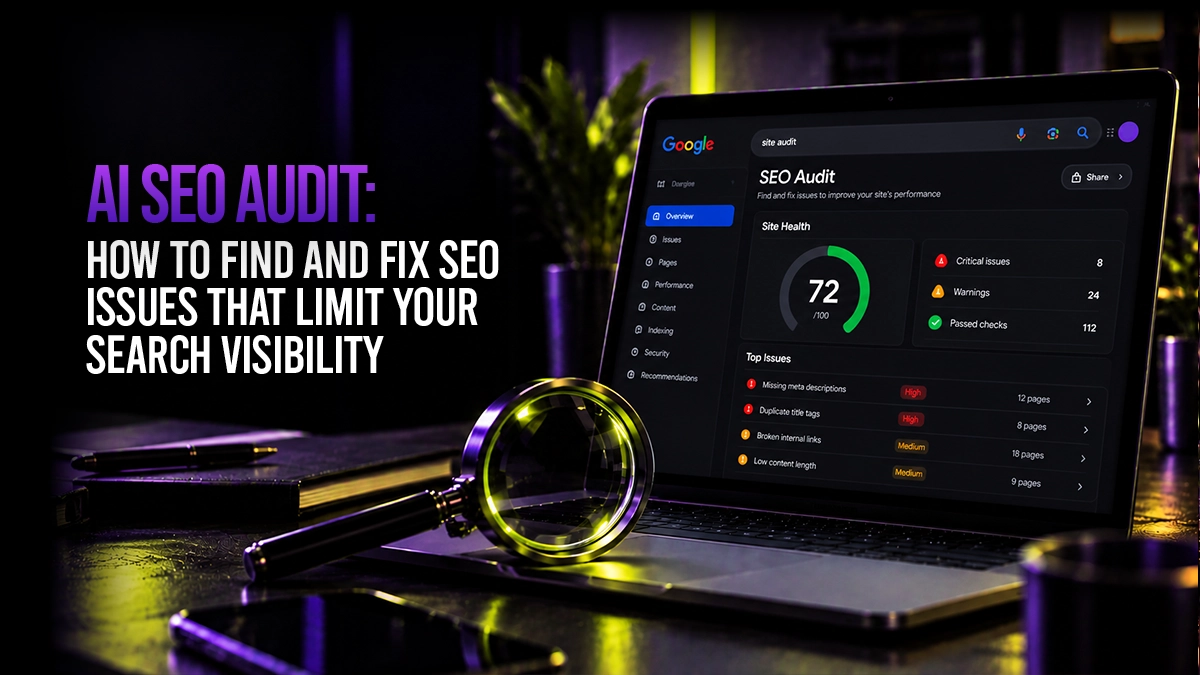
A website’s issues such as broken links, missing metadata, indexing problems, or slow pages can be identified through an ordinary SEO audit. But an AI SEO audit goes a step ahead by analyzing those findings at scale and looking for patterns across the site.
By combining crawl data, search performance, content, technical signals, and business context, AI can help identify recurring problems, uncover content gaps, compare pages, and prioritize what deserves attention first. But there is an important caveat: AI recommendations are only as reliable as the data, methodology, and validation behind them.
The most useful approach is therefore not “let AI audit my website.” It is a workflow: collect evidence, analyze it, diagnose the underlying problems, validate the findings, fix what matters, and measure the outcome.
What Is an AI SEO Audit?
An AI SEO audit is part of SEO services that uses artificial intelligence to analyze evidence, identify patterns, interpret problems, and assist with recommendations. The evidence can include:
Website crawl data
Page content
Google Search Console data
Analytics
Search results
Technical signals
Business priorities
This is different from simply giving ChatGPT a URL and asking it to list SEO problems. A credible AI-powered SEO audit needs real website and performance data. Without evidence, AI is largely making assumptions.
AI SEO Audit vs. Traditional SEO Audit
The biggest advantage of AI in SEO audits is its ability to analyze evidence at scale and with greater speed.
Traditional SEO audit | AI-assisted SEO audit |
Manual issue discovery | Large-scale pattern detection |
Page-by-page analysis | Cross-page comparison |
Manual content review | AI-assisted content analysis |
Individual errors | Issue clustering and root causes |
Manual recommendations | AI-assisted recommendations |
Periodic audit | Potential for continuous monitoring |
Automation is not a replacement for SEO expertise. AI changes the speed, scale, and analytical capability of an audit; it does not remove the need for sound SEO judgment.
What Data Does an AI SEO Audit Need?
The quality of an AI SEO analysis depends heavily on the evidence provided to it. Website data can include:
Crawlability
Indexability
URLs
Metadata
Page content
Internal links
Canonicals
Redirects
Structured data
Robots.txt
XML sitemaps
Performance signals
Search and performance data can include:
Google Search Console queries
Clicks
Impressions
CTR
Rankings
Landing pages
Changes over time
Context matters just as much. AI should understand the site’s:
Business goals
Important revenue pages
Target audience
Markets
Competitors
Strategic priorities
More data does not automatically produce better analysis. Poor, incomplete, outdated, or irrelevant data can lead even sophisticated AI SEO tools toward the wrong conclusion.
What Can AI Find During an SEO Audit?
The real value of AI SEO diagnostics is its ability to examine large datasets and recognize relationships between findings.
Technical patterns
Indexation issues
Canonical problems
Redirect chains
Broken links
Robots/noindex conflicts
Sitemap inconsistencies
Content patterns
Thin content
Duplicate/overlapping pages
Missing topic coverage
Outdated content
Metadata patterns
Search-intent mismatches
Architecture
Orphan pages
Weak internal linking
Deep page structures
Template-level problems
Performance
Core Web Vitals
Mobile issues
Large images
Slow resources
Semantic/entity layer
Missing relevant concepts
Weak topical coverage
Unclear entity relationships
Inconsistent business information
The important point is that AI is not merely finding individual errors. It can compare large numbers of pages and reveal problems that repeat across the website.
How AI Can Find Root Causes Instead of Just SEO Errors
This is where an AI-powered SEO audit can become substantially more useful than a conventional checklist.
Imagine 200 product pages with nearly identical metadata. A basic audit may produce 200 separate warnings. AI can compare those pages and recognize that the problem is probably not 200 unrelated mistakes. It may point toward a shared CMS template or product-page configuration.
The same principle applies elsewhere:
Multiple indexation problems → potentially one technical configuration issue
Repeated thin pages → potentially a weak content or template model
Internal-link gaps → potentially an architectural problem
Duplicate topics → potentially a content planning or cannibalization issue
The progression should be:
Individual findings → patterns → root cause → scalable fix
That shift from symptom detection to diagnosis is one of the strongest reasons to use AI in SEO auditing.
How AI Analyzes Content, Search Intent, and Semantic Relevance
An SEO audit should not stop at technical health. A page can be technically accessible and still fail to satisfy the searcher. AI can compare the relationship between query → search intent → current page → competing results → content coverage. This can help identify intent mismatches, missing subtopics, potential content overlap, entity gaps, and questions users may reasonably expect the page to answer.
This is also where Semantic SEO and Entity SEO become relevant. Semantic analysis is not simply about adding more related keywords. It is about understanding the concepts, entities, relationships, and context surrounding a topic. AI can make this comparison across many pages much faster, helping an SEO identify where topical coverage is genuinely weak rather than simply where a keyword is missing.
Why Human Validation Still Matters in an AI SEO Audit
AI can analyze evidence quickly, but it can also misinterpret context, work from incomplete information, make incorrect assumptions, or recommend technically inappropriate changes.
Human SEO review is particularly important for:
Page deletion or consolidation
Canonical changes
Noindex decisions
Large-scale redirects
CMS or template changes
Strategic content decisions
The principle is simple: AI identifies and explains patterns; SEO expertise determines whether the recommendation is correct.
How to Prioritize AI SEO Audit Findings
An audit becomes less useful when every warning is treated as equally important. A better prioritization model considers:
SEO impact + business impact + implementation effort + confidence
For example, a minor metadata issue on an old blog post should not automatically outrank an indexation problem affecting high-value product or service pages.
AI can help group findings, estimate their scale, identify affected URLs, and surface high-confidence patterns. But business context is needed to determine which problems should actually move to the top of the roadmap.
From AI Audit to SEO Fixes: The Complete Workflow
A practical SEO audit with AI should follow a repeatable process:
Collect evidence
Analyze with AI
Diagnose patterns
Validate findings
Prioritize actions
Implement fixes
Re-crawl and verify
Monitor performance
First, gather crawl, content, technical, search, analytics, and business data. Next, use AI to detect patterns and cluster related findings. Then diagnose likely root causes rather than treating every warning independently.
An SEO professional validates the diagnosis before implementation. Once fixes are deployed, the site should be re-crawled to confirm that the technical problem was actually resolved. Search and business performance can then be monitored to determine whether the change produced the intended result. This turns an audit from a static document into an improvement cycle.
Can an AI SEO Audit Include AI Search Visibility?
Yes, but AI search visibility should be treated as an additional audit layer rather than the entire audit. An audit can examine:
brand and entity mentions
how AI systems describe a business
competitor mentions
source or citation presence
content accessibility
visibility for conversational queries
However, technical SEO improvements do not guarantee visibility in ChatGPT, Google AI Overviews, Gemini, Perplexity, or other AI systems. AI-search visibility is evolving and should be monitored separately through AI and LLM SEO.
What Happens After an AI SEO Audit?
Instead of a spreadsheet full of warnings, an audit should end with an actionable roadmap. The final output should clearly show verified issues, root causes, priority, recommended fixes, responsible teams, and measurement criteria. This allows developers, content teams, and marketers to work from the same set of priorities.
Conclusion
An effective AI SEO audit is not about generating the longest possible list of SEO errors. Its real value is using AI to analyze more evidence, recognize patterns, uncover root causes, prioritize meaningful work, and accelerate the auditing process, while human expertise validates important decisions.
For businesses looking to turn those findings into measurable improvements, SEO services can provide the strategy, implementation, and ongoing optimization needed to move from diagnosis to growth.
FAQ
FAQs
What is an AI SEO audit?
+
An AI SEO audit uses artificial intelligence to analyze website, content, technical, and search-performance data to identify SEO issues, patterns, and potential root causes.
How is an AI SEO audit different from a traditional SEO audit?
+
A traditional audit often relies heavily on manual analysis, while an AI SEO audit can analyze large datasets, compare pages, detect recurring patterns, and help prioritize issues much faster.
Can AI tools find all SEO issues on a website?
+
No. AI SEO tools can identify many technical, content, and performance patterns, but they may miss context or misinterpret data. Human SEO validation is still important for strategic decisions.
What are the best AI SEO tools for an SEO audit?
+
The right tools depend on the audit’s goals. A strong process typically combines website crawling, Search Console and analytics data, content analysis, keyword research, and AI-assisted analysis rather than relying on one tool.
How often should you perform an AI SEO audit?
+
A comprehensive audit is useful when launching, redesigning, or significantly changing a website. Ongoing monitoring and regular SEO maintenance can then catch new issues before they affect search visibility.