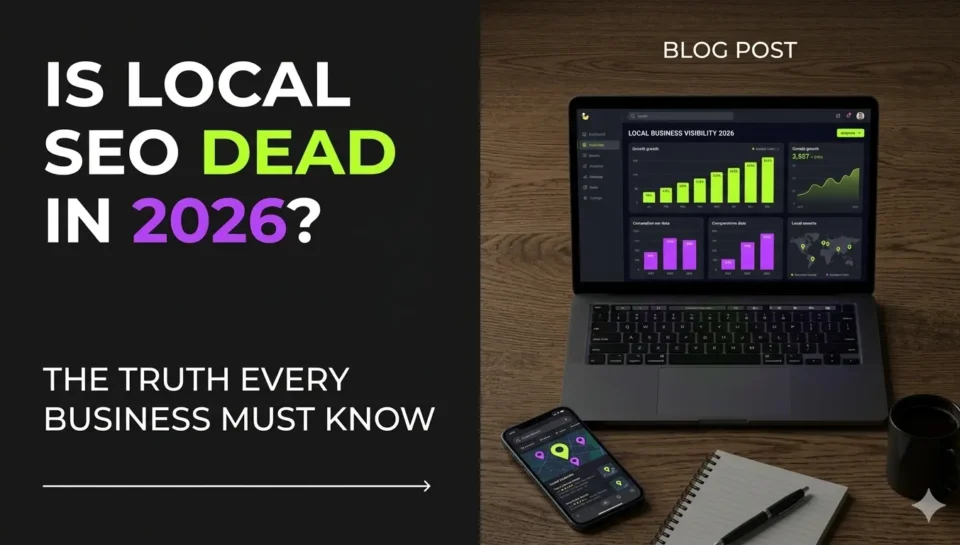
Is Local SEO Dead in 2026? The Truth Every Business Must Know
To answer the question promptly: No, Local SEO is not dead in 2026. What’s actually happening is a shift, driven by AI search, changing user behavior, and how platforms like Google present results.
Search today doesn’t look like it did even two years ago. You go for a Google search, type something in, and instead of clicking through websites, you’re often shown answers instantly. With AI-driven results, summaries, and recommendations, users don’t always need to visit a website anymore. This rise in zero-click searches has many businesses wondering: Is there even a point in Local SEO anymore?
The truth is Local SEO hasn’t disappeared. It has simply adapted to how people now search, ask questions, and make decisions.
Why Do People Think Local SEO Is Dying?
There’s a reason this question is trending.
1. AI is reducing clicks
With AI Overviews and conversational answers from tools like ChatGPT, users often get summarized answers instantly—no click needed.
2. Google shows answers directly
Search for “best dentist near me” on Google, and you’ll see maps, ratings, FAQs, and business details — all on the results page. This fuels the rise of zero-click searches.
3. Social platforms are becoming search engines
Users are increasingly using platforms like Reddit, TikTok, and Instagram as alternative “search engines.” People trust real opinions, community feedback, and unfiltered experiences more than polished websites.
So naturally, it feels like traditional Local SEO — rankings, keywords, websites — is losing its importance.
But that’s only half the story.
The Truth — Local SEO Is Evolving (Not Dead)
Despite all these changes, one thing hasn’t changed:
People still search for local services every single day.
- “Plumber near me”
- “Best brownies in California”
- “AC repair open now.”
And when they do, Google still prioritizes:
- Google Business Profile
- Google Maps
- Local Pack listings
These are core to local search results, and they’re not going anywhere.
Think about it practically. If someone in the US is craving brownies at 11 pm, they’re not reading a blog. They’re looking at nearby options, checking ratings, and deciding quickly. If your business shows up there, you win. If it doesn’t — you don’t exist. That’s the power of Local SEO in 2026.
How Local SEO Works in 2026?
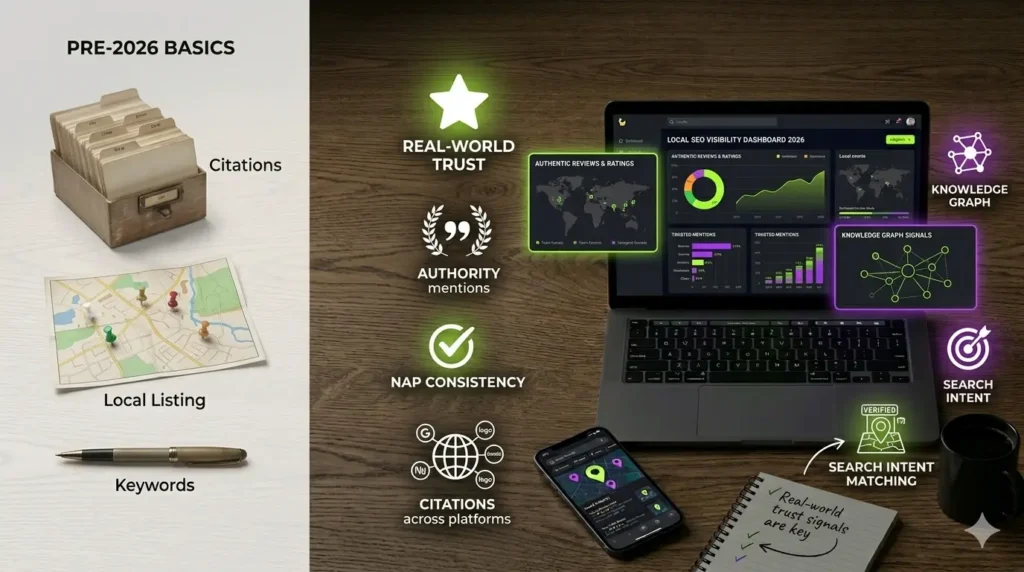
How Local SEO Works in 2026
What’s changed is not whether Local SEO matters — it’s how it works.
Earlier, you could get away with basic optimization: add keywords, list your business, maybe get a few backlinks.
Now, search engines and even AI systems are looking at a much deeper layer of signals.
They’re now looking at:
- Reviews and ratings
- Authority signals (mentions, backlinks, brand presence)
- NAP consistency (Name, Address, Phone)
- Citations across platforms
- Knowledge graph signals
- Search intent alignment
Google still relies on its classic factors relevance, proximity, and prominence but “prominence” today is heavily tied to real-world trust signals.
Your reviews, your activity, your consistency all of that matters more than ever. The fundamentals are still intact — but smarter.
The Role of AI in Local Search (New Change)
AI has fundamentally changed how people search. Instead of typing keywords, they’re asking full questions. For example,
Instead of typing:
“Coffee shop Florida”
Users now ask:
“Where should I go for a quiet coffee meeting in Florida?”
Tools like ChatGPT, Perplexity AI, and other AI-powered Google results are now recommending businesses, not just listing them.
That means your business is no longer competing just for rankings — it’s competing to be recommended.
And recommendations are built on:
- Trust
- Reputation
- Consistency
- Context
If your business has strong reviews, clear positioning, and a consistent presence, AI overviews and systems are far more likely to surface you.
What Actually Matters in Local SEO Today
This is where most businesses either win or completely miss the mark.
Local SEO in 2026 is no longer about “gaming the system.” It’s about showing up as a reliable, visible, and trustworthy business everywhere your customer might look.
Here’s what is actually driving local rankings in 2026:
- Google Business Profile optimization – Complete, accurate, regularly updated
- Detailed, authentic reviews – Not just ratings — written experiences
- Consistent business information – Across directories and platforms (citations)
- Active updates and engagement – Posts, photos, responses to reviews
- Website + content still matter – Especially for authority and context
- Schema markup implementation – Helps search engines understand your business
- E-E-A-T (Experience, Expertise, Authority, Trust) – Critical for both Google and AI systems
If you’re serious about growth, investing in professional local SEO services can help you execute all of this strategically instead of guessing your way through it.
Local SEO vs Traditional SEO (Quick Comparison)
Traditional SEO still focuses heavily on keywords, backlinks, and ranking pages globally.
Local SEO, on the other hand, is far more grounded in reality. It’s about your location, local intent, and customers’ trust and reviews.
You’re not just optimizing for search engines anymore — you’re optimizing for real-world decisions.
That’s why concepts like entity SEO and brand authority are becoming more important. Your business is being evaluated as a whole — not just as a website.
New Concept GEO (Generative Engine Optimization)
You may have heard about GEO (Generative Engine Optimization). It’s essentially about optimizing your presence and content to appear in AI recommendations. But here’s the important part: GEO doesn’t replace Local SEO. It builds on it.
If your Local SEO foundation is weak — inconsistent data, poor reviews, inactive presence — no amount of GEO will help you. But if your foundation is strong, GEO amplifies your visibility across AI platforms.
For example, strong review sentiment and contextual authority help both Google rankings and AI recommendations.
Think of it this way: Local SEO helps you exist. GEO helps you get recommended.
What Businesses Should Do Now (Actionable Section)
If you want to win in 2026, focus on execution — not theory.
1. Optimize your Google Business Profile
Keep it complete, updated, and active.
2. Get real, detailed reviews
Encourage customers to write about their experience — not just leave stars.
3. Maintain consistent citations
Your business info should match across all platforms.
4. Create helpful, local-focused content (Content marketing)
Answer real customer questions, address their concerns, and show your expertise.
5. Be active across various social platforms
Google is not the only discovery channel anymore:
- Social media
- Review platforms
- Forums
Final Verdict
Local SEO is not dead. It is evolving rapidly. The businesses that adapt to this shift will continue to dominate locally. The ones that don’t will slowly fade out — not because Local SEO stopped working, but because they stopped evolving with it.
If you’re serious about growth, combining specialized local SEO services with broader SEO services can help you build both local visibility and long-term search authority.
FAQs
Q1. Is Local SEO dead in 2026?
No, Local SEO is not dead in 2026. It has evolved due to AI search, zero-click results, and changing user behavior. Search engines and AI systems still rely on local signals like Google Business Profile, reviews, and business credibility to recommend local businesses.
Q2. Is Local SEO still worth it in 2026?
Yes, Local SEO is more valuable than ever. Local searches show strong buying intent, meaning users are ready to take action. Businesses that appear in Google Maps, local packs, and AI recommendations gain high-converting traffic and better ROI.
Q3. How do you rank in local search results in 2026?
To rank locally in 2026, focus on these key factors:
- Optimize your Google Business Profile with accurate and updated information
- Collect detailed, authentic customer reviews
- Maintain consistent NAP (Name, Address, Phone) across all platforms
- Publish helpful, location-focused content
- Stay active on social platforms and review sites
These signals help both Google and AI systems understand and trust your business.
Q4. Does AI replace Local SEO?
No, AI does not replace Local SEO. AI changes how results are presented, but it still depends on Local SEO signals like reviews, authority, and consistency. Strong Local SEO increases your chances of being recommended in AI-generated results.