hello@synaryverse.com
What Is Motion Graphics Animation? Definitions, Use Cases, and How It Differs from VFX

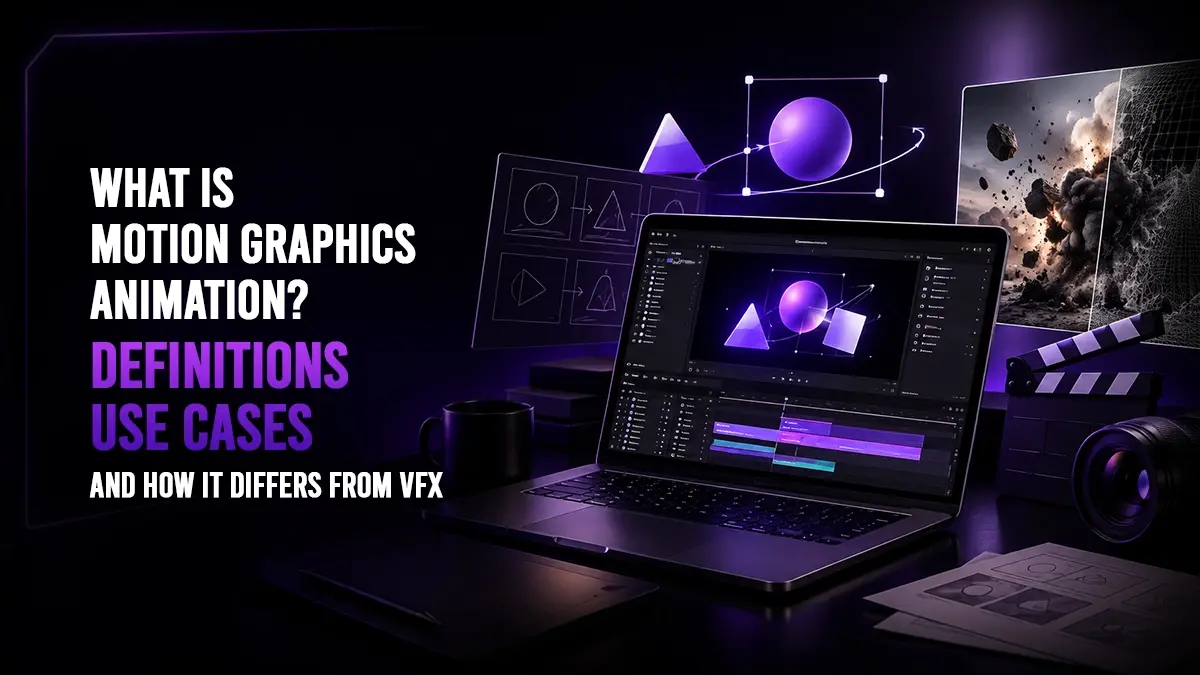
You’ve probably seen motion graphics without realizing it. The animated logo before a YouTube video starts. Numbers climbing on a financial report. Text appearing beside a person in an advertisement. A product diagram breaking apart to show how something works. Even the animated icons and transitions in an app can fall under motion graphics.
So, what is motion graphics animation? In simple terms, it is adding ‘motion’ to graphic design elements - such as text, shapes, illustrations, icons, logos, charts, and other visual assets. Adobe describes motion graphics as essentially “graphics with movement”. But there is more to it than making things move.
Good motion graphics combine design, animation, timing, sound, storytelling, and brand identity to communicate an idea quickly and make it easier to remember.
What Makes Motion Graphics Different From Regular Animation?
Motion graphics is technically a type of animation, but the two terms are not interchangeable. Traditional animation often focuses on characters, personalities, environments, and narrative storytelling. Motion graphics tends to be more communication-driven.
Instead of animating a character for a five-minute story, a motion designer might animate:
A statistic to make a business result easier to understand
A logo to strengthen brand recognition
Product features for a technology advertisement
A timeline or process for an explainer video
Typography for a social media campaign
An interface for a product demonstration
Icons and illustrations for an educational video
What Are Motion Graphics Used For?
Today, businesses use motion graphics across websites, social media, presentations, advertisements, product demonstrations, corporate communications, and more.
1. Explainer Videos
Complex products and services are often difficult to explain with words alone. Motion graphics can break an idea into smaller visual steps.The animation provides a visual structure for the explanation.
2. Brand Videos and Logo Animation
An animated logo can establish identity and personality. Logo reveals, animated brand marks, transitions, typography, and branded backgrounds can create a consistent visual language across video content.
3. Social Media Content
Short-form platforms have created an enormous need for visual content that communicates quickly. Motion graphics can turn:
A statistic into an animated visual
Customer quote into an engaging social post
Product feature into a short demonstration
Blog insight into a video
Promotional message into an animated advertisement
4. Data Visualization
This is one of the most practical applications, and one that deserves more attention. Numbers don’t automatically become interesting just because they’re placed on a screen. Motion can show change over time.
Instead of displaying a static graph showing revenue growth, for example, animation can reveal the data progressively, highlight the important turning point, and direct the viewer’s attention to the conclusion.
For financial services, healthcare, technology, research, and corporate presentations, this can make complicated information considerably easier to follow.
5. Product Demonstrations
Some products are difficult to demonstrate physically. A motion graphics sequence can show what’s happening inside a machine, how software works behind the interface, how a product is assembled, or how different components interact.
 Motion Graphics vs. VFX: What’s the Difference?
Motion graphics generally creates movement for designed visual elements. VFX modifies, creates, or enhances imagery, often in combination with live-action footage.
Consider these examples.
Motion Graphics | VFX |
Animated logo | Removing an object from footage |
Kinetic typography | Creating a digital creature |
Animated infographic | Adding explosions to live footage |
Moving icons | Replacing a background |
Product diagrams | Creating a digitally generated environment |
Animated charts | Integrating CGI into live-action footage |
Modern production software can combine motion graphics, compositing, 2D animation, 3D elements, and VFX within the same project. Adobe After Effects, for example, is used for both motion graphics and visual effects.
If the objective is to communicate information through animated design, motion graphics is often the natural choice. If the objective is to alter or enhance filmed reality, VFX is more likely to be involved.
How Is Motion Graphics Actually Created?
A professional motion graphics project typically starts long before animation begins. A simplified workflow looks like this:
Concept → Script → Storyboard → Design → Animation → Sound → Review → Delivery
First, the creative team determines what the audience needs to understand or feel. Then the script and storyboard establish the visual sequence. Designers create the graphic elements, followed by animation using techniques such as keyframing, easing, masking, transitions, camera movement, and sometimes 3D animation.
Sound design is another important, but frequently overlooked, piece of the puzzle. A subtle sound effect can make a transition feel intentional; music can influence pacing and emotion.
Final Thoughts
Motion graphics animation sits at an interesting intersection of graphic design, animation, video, and storytelling. It can make a logo memorable, a statistic understandable, a product easier to explain, and a complicated concept far less intimidating.
The biggest opportunity for businesses may be thinking beyond a single animated video. When motion is designed as a reusable system, one creative investment can support advertisements, social content, presentations, explainers, product videos, and branded communications for months or even years.
That’s when motion graphics services stop being decoration and start becoming a business communication tool.
FAQs
What is motion graphics animation in simple terms?
+
Motion graphics animation is the process of animating graphic design elements such as text, logos, shapes, illustrations, icons, and charts. It is commonly used to explain information, promote products, and strengthen visual branding.
Is motion graphics the same as animation?
+
Not exactly. Motion graphics is a type of animation, but animation is a broader category. Animation can include character animation, stop motion, 2D animation, 3D CGI, and motion graphics. Motion graphics typically focuses on animated graphic design rather than character-led storytelling.
What is the difference between motion graphics and VFX?
+
Motion graphics primarily animates designed elements, while VFX creates or alters visual imagery, frequently in combination with live-action footage. However, professional productions can use both techniques in the same project.
What software is used for motion graphics?
+
Adobe After Effects is one of the major tools used for motion graphics. Depending on the project, professionals may also use 3D, illustration, editing, compositing, and sound-design software. After Effects supports animated text, graphics, illustrations, 3D elements, tracking, compositing, and reusable motion templates.
How long does it take to create a motion graphics video?
+
It depends on duration and complexity. A short social media animation may take considerably less time than a custom 3D explainer with original illustrations, complex animation, voiceover, and sound design. Script development, revisions, illustration, animation style, and the number of deliverables can all affect the timeline.
Is motion graphics effective for marketing?
+
Yes, particularly when movement helps communicate something that would be difficult to understand through static visuals alone. Motion graphics can be used for advertisements, product demonstrations, explainers, social content, data visualization, presentations, and brand communications.