 hello@synaryverse.com
In this article+
- What Is Semantic SEO?
- What Is Entity SEO?
- Semantic SEO vs. Entity SEO: What’s the Difference?
- Keywords, Topics, and Entities: What’s the Difference?
- How Entity Relationships Help Search Engines Understand Content
- How Search Intent and Context Strengthen Semantic SEO
- Building Topical Authority With Semantic Content Clusters
- How to Strengthen Your Website’s Entity Signals
- 1. Define your core entities
- 2. Document important attributes
- 3. Map entity relationships
- 4. Maintain consistency
- 5. Create supporting content
- 6. Connect relevant pages
- Structured Data, Schema, and Entity Understanding
- How Semantic SEO Supports AI and LLM Search
- A Practical Semantic and Entity SEO Workflow
- Conclusion
Search engines have gotten smarter. They no longer match a search query with the exact keywords on a webpage. Today, they actually ‘understand’ a query. This means interpreting what the searcher means, which topic they are exploring, which entities are involved, and how those entities relate to one another.
That shift has changed how businesses should approach SEO. Repeating a target phrase across a page is no longer enough. Search engines need relevance. Relevance in context, useful information, clear relationships, and content that satisfies the purpose behind a search.
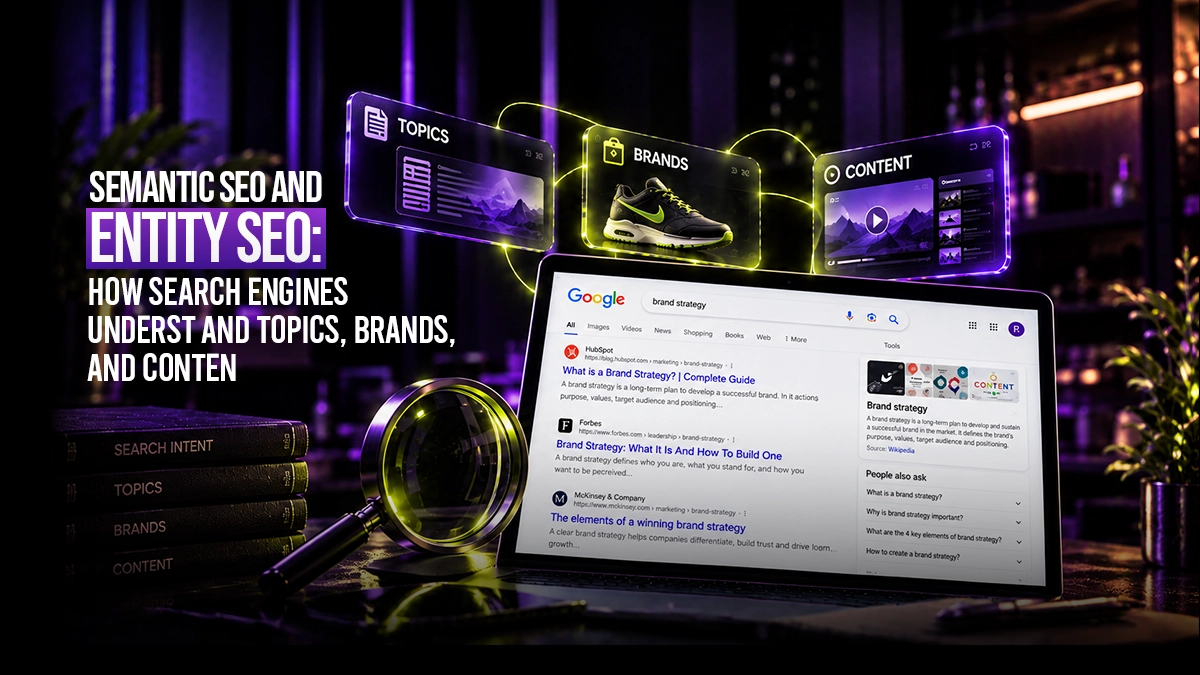
This is where Semantic SEO and Entity SEO become valuable. Semantic SEO helps establish meaning and context around a topic, while Entity SEO helps search systems identify important people, businesses, products, services, places, and concepts and understand how they connect.
What Is Semantic SEO?
Semantic SEO is the practice of optimizing content around meaning, context, concepts, and search intent rather than focusing exclusively on an exact keyword. Semantic search allows search engines to interpret the relationship between words and the underlying subject of a query. For example, someone searching for “how to improve website visibility” may not use the phrase “SEO strategy” at all, yet the concepts are closely connected.
A semantic approach considers:
Search intent
Related concepts and questions
Topic depth
Context and terminology
Natural language
Comprehensive coverage
This does not mean filling an article with synonyms or related keywords. In fact, that can make content awkward and repetitive. The objective is to cover the subject deeply to ensure important concepts are explained where they genuinely belong.
What Is Entity SEO?
An entity is a distinct, identifiable thing or concept. It could be a person, business, organization, product, service, place, brand, or even an abstract concept. Entity SEO focuses on making those entities and their characteristics easier for search systems to understand.
A useful way to think about entity optimization is:
Entity → attributes → relationships → context
Consider a business. It can have attributes such as its name, industry, location, services, expertise, and website. It can also have relationships with other entities.
For example:
A business → provides → SEO services → for → businesses
Or:
An SEO agency → offers → technical SEO → to → ecommerce businesses
These relationships add meaning that an isolated mention cannot provide. Entity-based SEO therefore goes beyond identifying what is being discussed. It helps establish what that thing is, what it does, and how it connects to other relevant concepts.
Semantic SEO vs. Entity SEO: What’s the Difference?
Semantic SEO and Entity SEO overlap, but they solve slightly different problems.
Semantic SEO | Entity SEO |
Focuses on meaning and context | Focuses on identifiable entities |
Addresses topics and search intent | Defines entities and their attributes |
Builds topical depth | Clarifies entity relationships |
Connects related concepts | Connects identifiable things |
Relies heavily on content and context | Can also involve structured data and entity consistency |
In practice, the two approaches work best together. Semantic SEO provides the surrounding context, while Entity SEO clarifies the important entities within that context.
Keywords, Topics, and Entities: What’s the Difference?
One of the most important distinctions in modern SEO is understanding the difference between a keyword, topic, and entity.
A keyword is a word or phrase people use when searching.
A topic is the broader subject represented by multiple related searches and concepts.
An entity is a distinct thing or concept that can be identified and connected to other entities.
For example:
Keyword: SEO services
Topic: Search engine optimization
Entities: SEO agency, technical SEO, local SEO, ecommerce SEO, Google Search
Relationship: SEO services → includes → technical SEO
This distinction matters because optimizing an entire information structure is generally more useful than repeatedly optimizing one phrase. Instead of creating a page simply because “SEO services” has search volume, a business can address what SEO services actually involve, who needs them, which types exist, how technical SEO differs from local SEO, and how these services support business goals. That creates a stronger and more useful topical framework.
How Entity Relationships Help Search Engines Understand Content
An entity becomes more meaningful when its relationships with other entities are clear.
Consider some common relationships:
Organization → offers → service
Product → belongs to → category
Person → works for → organization
Service → solves → business problem
Place → located in → region
Brand → associated with → product or service
Attributes can add another layer of context. For example:
Business entity: Synaryverse
Type: Organization
Service: SEO
Market: USA
The important point is not simply mentioning these facts repeatedly. They should be represented consistently and supported by relevant website content. A service page can explain what the service does. An about page can establish the organization. Author pages can provide information about people associated with the business. Supporting articles can demonstrate expertise around the relevant subject.
These connections give search systems more context for interpreting individual pieces of information. However, mentioning entities or relationships does not automatically produce rankings or search visibility. Search engines still evaluate many other signals, including relevance and content quality.
How Search Intent and Context Strengthen Semantic SEO
Search intent is another essential part of semantic search SEO. A query can have different purposes, including:
Informational: The user wants to learn something.
Commercial investigation: The user is comparing options before making a decision.
Transactional: The user is ready to take an action or purchase.
Navigational: The user is looking for a particular website, brand, or destination.
The same entity can appear in all four contexts.
For example, “What is technical SEO?” is primarily informational, while “SEO services for small businesses” suggests commercial investigation. A strong page therefore should not simply contain the relevant terminology. It should satisfy the query purpose. This is one reason search intent belongs at the center of both semantic and entity-based SEO strategies.
Building Topical Authority With Semantic Content Clusters
Topical authority is not created by publishing dozens of loosely related articles. It comes from developing meaningful coverage around a subject.
A practical structure looks like this:
Pillar topic → subtopics → supporting content → contextual internal links
Suppose the main topic is ecommerce SEO. Supporting pages might cover product page optimization, category pages, technical SEO, faceted navigation, internal linking, structured data, and ecommerce content strategy. This creates both topic breadth and topic depth.
Search intent should also influence the cluster. One page might explain a concept, another might compare approaches, and another might address a commercial need.
Internal links then connect these pages based on their meaning. A technical SEO article should link to a relevant guide on crawling or indexing because the concepts are connected. This creates a coherent content ecosystem rather than a collection of isolated blog posts.
How to Strengthen Your Website’s Entity Signals
A practical entity SEO strategy can be built in six steps.
1. Define your core entities
Identify your brand, business, people, products, services, locations, and major subject areas.
2. Document important attributes
Record information such as industry, expertise, service categories, locations, product characteristics, and target audiences.
3. Map entity relationships
Determine how your services, products, people, categories, and topics connect. For example, which services solve which customer problems?
4. Maintain consistency
Keep important entity information accurate and consistent across relevant website pages and external business profiles.
5. Create supporting content
Publish useful content that answers questions and explores related concepts surrounding your core entities.
6. Connect relevant pages
Use contextual internal links to reinforce relationships between related pages, services, topics, and entities.
Structured Data, Schema, and Entity Understanding
Structured data provides machine-readable information about content and entities. Schema.org includes types such as Organization, Person, Product, Article, LocalBusiness, Service, and BreadcrumbList.
For example, Schema.org’s Service type can describe information such as the provider, service type, and area served. Structured data can help search engines interpret specific information on a page, but it should accurately represent the visible content. It is not a shortcut to rankings. For that reason, schema works best as part of a broader content, entity, and technical SEO strategy.
How Semantic SEO Supports AI and LLM Search
AI-powered search systems also need to interpret context, entities, relationships, expertise, and supporting information when generating or retrieving answers. That makes AI and LLM SEO, including semantic SEO and entity optimization, increasingly relevant to how brands organize information online. Clear product and service descriptions, consistent brand information, useful supporting content, and logical relationships between pages create a stronger information environment.
This does not mean that semantic optimization automatically makes a business appear in AI-generated answers. Visibility depends on many factors and cannot be guaranteed.
Instead, the connection is more fundamental: websites that clearly organize information around topics and entities are better positioned to provide understandable, evidence-supported information to modern search systems.
A Practical Semantic and Entity SEO Workflow
Rather than treating semantic and entity optimization as isolated tactics, build them into your regular SEO process:
Identify core entities
Map attributes and relationships
Research topics and search intent
Build relevant topic clusters
Create comprehensive, people-first content
Connect related pages with contextual internal links
Implement relevant structured data
Review, expand, and maintain the ecosystem
Conclusion
Modern SEO is no longer simply about matching a search query with a keyword on a webpage. Strong optimization connects topics, entities, relationships, context, search intent, and content architecture.
Semantic SEO establishes meaning and topical context, while Entity SEO clarifies important things being discussed and how they relate. Together, they create a more coherent information structure for both users and search systems.
Broader SEO services can help connect technical optimization, content strategy, entity signals, and topical authority into one framework.
FAQ
FAQs
What is the difference between Semantic SEO and Entity SEO?
+
Semantic SEO focuses on meaning, context, related concepts, and search intent. Entity SEO focuses on identifiable things such as businesses, people, products, services, and their attributes and relationships. The two approaches complement each other.
Does Semantic SEO mean using more related keywords?
+
No. Semantic SEO is not about adding synonyms or related keywords simply to increase keyword coverage. It means creating content that genuinely explains the topic, addresses related concepts, and satisfies the searcher’s intent.
How do entities affect SEO?
+
Entities help provide context about the people, businesses, products, services, places, and concepts discussed on a website. Clear entity information and relationships can make content easier for search systems to interpret, although entity optimization alone does not guarantee higher rankings.
Is structured data necessary for Entity SEO?
+
Structured data is useful but not mandatory for every aspect of entity optimization. It provides machine-readable information about eligible content and entities, but accurate on-page content, consistent information, site architecture, and contextual relationships remain important.
How can a business start using Semantic and Entity SEO?
+
Start by identifying your core business entities, documenting their attributes, mapping their relationships, researching related topics and search intent, and building content clusters around those subjects. Then strengthen the connections with contextual internal links and relevant structured data.