 hello@synaryverse.com
How Google Actually Ranks Lawyer GBP in 2026: Complete Guide to Google Maps Ranking, Local SEO & AI Optimization

Ranking a lawyer's Google Business Profile in 2026 is, in no way, on par with Google’s traditional ranking system; it has become much more sophisticated. The keyword stuffing in business descriptions or collecting a few directory links that once earned you a top search rank are now not enough. For law firms that earn a rank in the local 3-pack today, Google needs to clearly understand the business, its online presence should build trust, and real users should strongly engage with its profile.
This is especially important for attorneys, as local legal search is high-intent. Someone searching “family lawyer near me,” “divorce attorney in Dallas,” or “criminal defense lawyer open now” is not browsing casually. They are actively looking for legal help, and the results showing in the Google Maps 3-pack are strongly positioned to receive the call from the potential client.
Therefore, Google Business Profile (GBP) optimization for lawyers requires a serious local SEO strategy. In this guide, we will walk you through how Google actually ranks lawyers' Google Business Profiles in 2026, what factors matter the most, how law firms can build long-term visibility, and how AI plays a role in this.
How Google Ranks Lawyer Google Business Profiles in 2026
Relevance, Distance, and Prominence explained in real terms
Generally, Google uses three primary factors to rank a local business: Relevance, Distance, and Prominence.
Relevance means how well your business matches the search intent.
Distance looks at how close your business is to the searcher or the desired location.
Prominence indicates how well-known and trusted your business is.
Why Google Maps is now an entity-driven system
The reliance on ‘entities’ for ranking shows that Google Maps now delivers a more context-aware and personalized search experience. This is primarily due to the shift in search behaviour. Users input questions rather than keywords in the search bar, and expect results that are locally and contextually relevant.
This, and the introduction of AI, made Google Maps an entity-driven system rather than a static, A-to-B navigation tool that treats real-world businesses as complete entities. For law firms, this means Google wants to understand your full name, attorneys, practice areas, office location, legal credentials, reputation, reviews, website content, and third-party mentions as one connected identity. This is where many law firms fall behind because an entity-driven system rewards consistency and clarity.
Why most law firms fail to reach the 3-pack
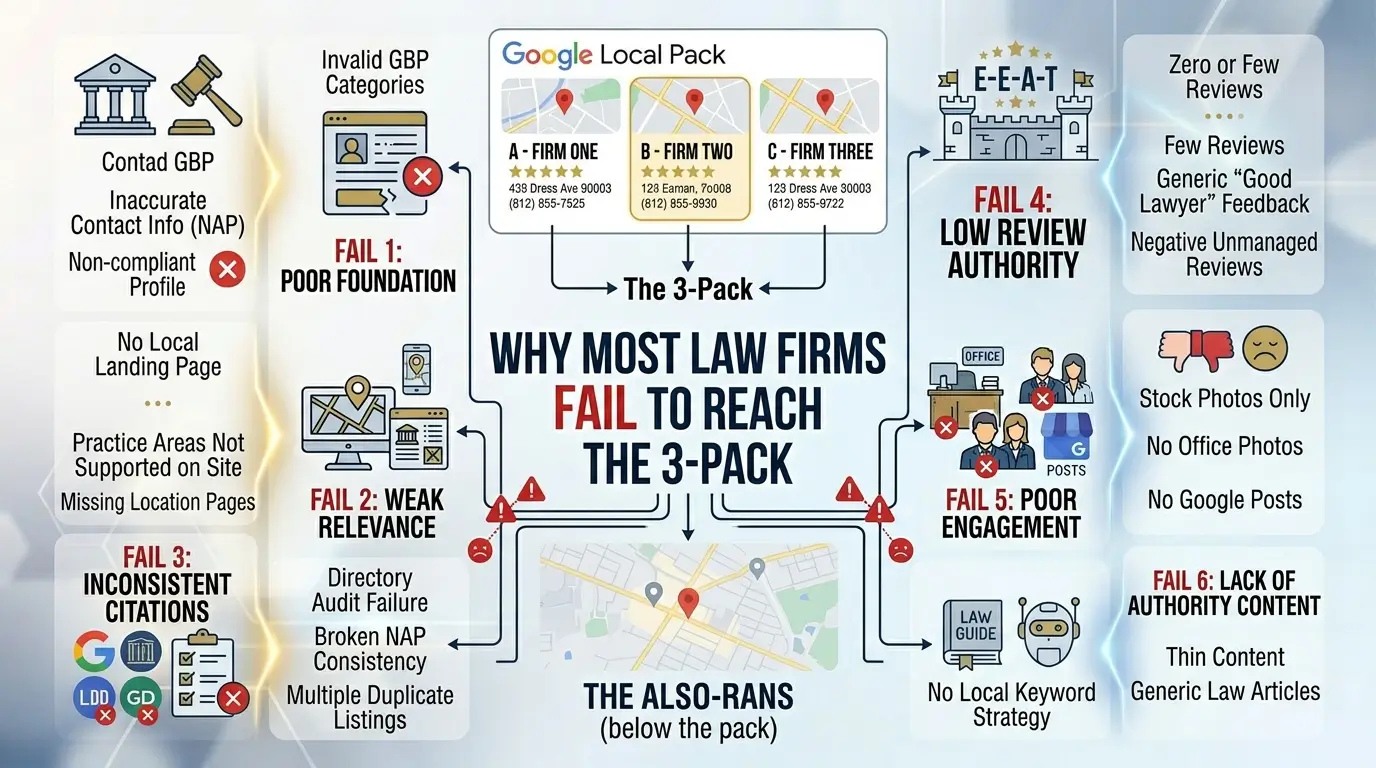 The biggest mistake many law firms make is treating Google Maps ranking as a checklist, in isolation, while it reads much more than your GBP. It compares your profile against your website, legal directories, service pages, and bios. Many legal firms may have an optimized Google Business Profile but a disconnected online presence. Their website says one thing, and their directories say another, their attorney bios are not descriptive, and their citations have inconsistencies in addresses, names, or phone numbers. All of this leads to low confidence in your firm’s identity, thereby leading to a failure in reaching the top 3 rank.
Google Maps Ranking System for Law Firms (Beyond SEO Checklists)
Basic Local SEO is still important, but it is no longer enough. Your business still needs the correct name, address, phone number, business hours, and website links, but it just lays the foundation for your basic optimization. Competitive legal markets need much more - they need entity SEO.
Entity SEO focuses on the latest Google systems and, accordingly, helps it understand your business. To make your law firm locally visible in 2026, you need to make sure that Google understands your firm as a real, trusted legal service entity. This includes factors that go beyond checklist SEO, which targets tasks.
Your law firm should look like one clear entity across the web. This means the same firm name, office address, phone number, practice areas, attorney identities, brand language, and local service footprint. When Google sees consistency across GBP, website, FindLaw, Justia, and other local citations, it becomes easier to trust who you are and what you do.
Law Firm Entity Authority Model
As mentioned earlier, Google no longer views your GBP in isolation; instead, it considers your overall online presence to determine your law firm's trustworthiness and relevance. This is where the law firm entity authority model becomes important. Your Google Business Profile, website, attorney bios, legal directory, citations, backlinks, and reviews all work together to build your digital presence. The stronger and more consistent that identity is, the easier it becomes for Google to trust your law firm and list it in local legal searches.
Legal directories also play an important role and act as authority nodes. Listing on platforms like Avvo, Justia, and FindLaw gives Google external confirmations that your firm and attorneys exist in the legal ecosystem.
Behavioral Ranking Signals That Control Google Maps Visibility
Engagement is essential from a local SEO perspective. Although Google has not defined a simple formula for it, suggesting that more calls mean better rankings, it is important because Google Maps is built around user satisfaction. Engagement can take various forms - profile visits, clicks, calls, direction requests, reading reviews, or website visits. All of these actions suggest that your listing is useful.
This is a major pit for law firms that reduces their visibility. Many firms optimize their profile once, but do not work on giving people a reason to engage with it. A strong lawyer GBP should answer the user’s immediate questions, like, What type of lawyer are you? How much experience do you have? Where are you located? Can I call you now? Do other clients recommend you?
The more useful the profile is, the more likely users are to interact with it and subsequently signal Google Maps to improve the visibility.
AI & LLM Optimization for Google Business Profile (2026 Layer)
In 2026, law firm SEO also needs to consider Google AI Overviews and AI-driven interpretation. Google says its AI features in Search are rooted in its core ranking and quality systems, and that traditional SEO best practices still matter for AI experiences. This means there is no magic “AI SEO trick.” But there is a real need for semantic clarity.
Google’s AI systems need to understand your firm without confusion. If your website says “legal experts,” your GBP says “law office,” your directories say “trial attorneys,” and your service pages are vague, you make it harder for search systems to confidently classify your business.
For lawyer GBP optimization, semantic clarity means using precise language, like “Personal injury lawyer in Chicago” is clearer than “legal solutions provider.”
AI systems extract meaning from patterns. Your law firm should create consistent patterns across its GBP, website, schema, content, reviews, and citations.
To optimize for AI Overviews and LLM-style search, law firms should focus on:
- Clear practice area pages.
- FAQ sections that answer real client questions.
- Attorney bios with credentials and experience.
- LocalBusiness and legal service schema where appropriate.
- Consistent NAP across the web.
- Review themes that match your services.
- Content that demonstrates experience, not generic legal definitions.
Google also emphasizes helpful, reliable, people-first content. For legal websites, this is especially important because users are often dealing with serious personal, financial, or legal problems.
Step-by-Step System to Rank a Lawyer GBP #1
Ranking number one is never guaranteed, and no agency should promise it. Google itself states that you cannot request or pay for a better local ranking.
However, you can build the strongest possible ranking foundation with Local SEO Services.
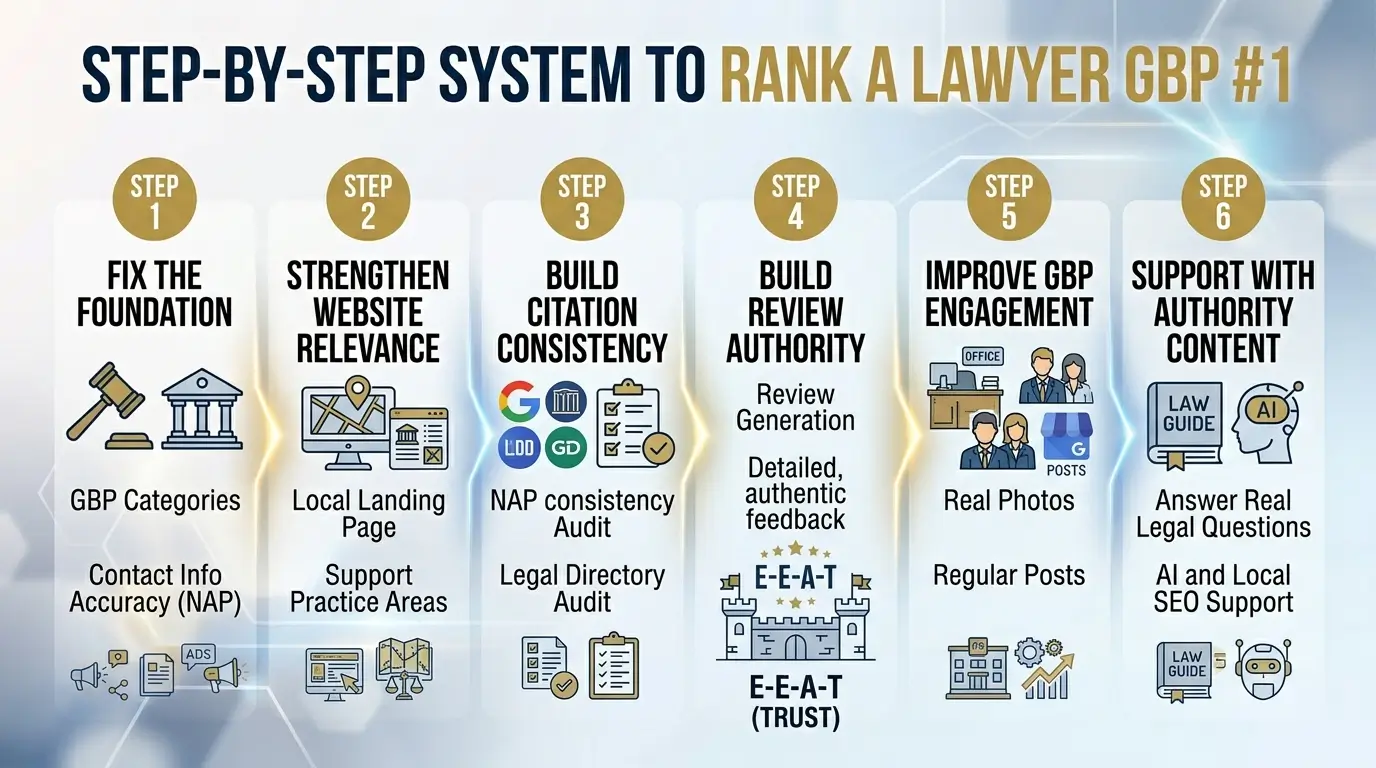 1. Fix the foundation
Start with your Google Business Profile. Choose the most accurate primary category, such as “Personal Injury Attorney,” “Criminal Justice Attorney,” “Family Law Attorney,” or “Estate Planning Attorney.” Add secondary categories only when they genuinely apply.
Make sure your firm name, address, phone number, website, business hours, appointment link, and service areas are accurate. Add all relevant services, but avoid adding practice areas you do not actually handle.
2. Strengthen website relevance
Your GBP should connect to a strong local landing page or homepage. That page should clearly support the same practice areas and location you want to rank for. If your profile targets “immigration lawyer in Miami,” your website must reinforce that entity with relevant content, attorney experience, location signals, testimonials, and FAQs.
3. Build citation consistency
Audit legal directories and local listings. Make sure your firm name, address, and phone number are consistent across major platforms. In legal SEO, citations from legal directories can be especially valuable because they confirm both your business identity and your legal category.
4. Build review authority
Reviews still matter because they influence trust, conversion, and local prominence. But law firms should focus on authentic review generation, not volume alone. A review that says “Great lawyer” is helpful. A review that says “They helped me through a child custody case and explained every step clearly” gives much more context. Respond to reviews professionally. For legal services, avoid revealing confidential details in responses.
5. Improve GBP engagement
Add real photos of your office, attorneys, consultation rooms, signage, and team. Use Google Posts where relevant. Keep hours updated. Add FAQs. Make calling easy. A profile that feels active and complete is more likely to earn user trust.
6. Support with authority content
Publish content that answers real legal questions in your market. Not thin, generic articles. Useful content. This helps your law firm become more relevant to local legal searches and supports both traditional SEO and AI visibility.
Why “Rank in 30 Days” Claims Are Misleading
Some agencies claim they can rank a lawyer on Google Maps in 30 days. In low-competition markets, quick movement can happen. But in competitive legal niches, ranking usually depends on the strength of your existing authority.
A brand-new law firm with no reviews, weak citations, no local content, and a thin website will not outrank established competitors overnight. Optimization can improve the profile quickly, but authority takes time.
Ranking speed depends on:
Market competition.
Practice area difficulty.
Review quality and frequency.
Website authority.
Citation consistency.
Proximity to searchers.
Competitor strength.
Existing brand demand.
The goal should not be temporary visibility. The goal should be sustainable ranking power that continues to grow month after month.
Common Mistakes That Prevent Law Firms from Ranking
Some basic and common mistakes prevent law firms from ranking:
Weak category selection - if your primary category is too broad or inaccurate, Google may not clearly understand your core service.
Inconsistent citations - these significantly dilute trust signals. For example, using an old phone number or inconsistent names across different directories.
Thin service content - a law firm cannot expect to rank for a service if the website barely explains that it provides that specific service.
Ignoring reviews - a firm with weak review quality or negative reviews may struggle to earn calls even if it appears in Maps.
Treating AI optimization as separate from SEO - in reality, AI visibility is part of your SEO strategy as it depends on clarity, authority, structure, and trust.
Final Thoughts
Ranking a lawyer's Google Business Profile in 2026 requires more than profile optimization. It requires a complete local SEO system built around trust, clarity, authority, and user engagement. For law firms that want stronger visibility in Google Maps, the best strategy is not to chase shortcuts. It is to build a profile and digital presence that deserves to rank.
FAQs
How do lawyers rank in Google Maps?
+
Lawyers rank in Google Maps by improving relevance, distance, and prominence. This includes optimizing the Google Business Profile, choosing accurate categories, building reviews, maintaining citation consistency, strengthening website authority, and creating clear local practice area content.
How long does it take to rank a law firm GBP?
+
It depends on competition, location, reviews, citations, website strength, and existing authority. Some improvements may show within weeks, but competitive legal markets often require several months of consistent local SEO work.
What affects Google Maps ranking the most?
+
The biggest factors are relevance, distance, and prominence. For law firms, this translates into accurate GBP optimization, proximity to the searcher, strong reviews, legal directory consistency, website authority, and clear practice area relevance.
Do reviews still matter for GBP rankings?
+
Yes. Reviews support trust, prominence, and conversion. Quality, recency, detail, and response management all matter. Law firms should build a steady review process while staying compliant with legal and ethical standards.
Why is my law firm not showing in Google Maps?
+
Your law firm may not show because of weak relevance, poor category selection, low authority, inconsistent citations, lack of reviews, proximity limitations, or a website that does not support your target practice areas and location.

