hello@synaryverse.com
All-in-One Creative Services for Enterprises: What Full-Service Actually Delivers

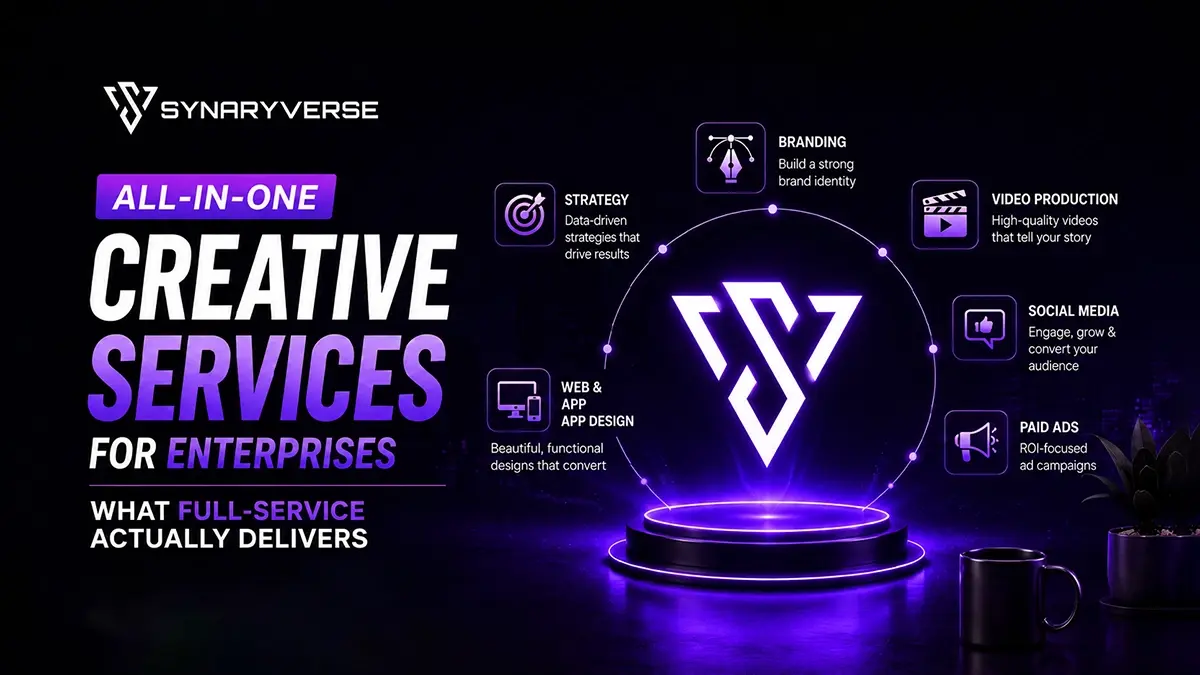
All-in-One Creative Services for Enterprises: What Full-Service Actually Delivers
Enterprise-level creative work often demands scalability, brand consistency, and fast execution. The problem with this scale of work is not usually budget or the lack of vendors; it is the decentralized management that causes too many vendors to work from different briefs, timelines, systems, and interpretations of the brand.
One team handles the website. Another produces videos. A different person writes content. The result is often slow execution, inconsistent branding, duplicated effort, and a lot of hidden management work.
That is where all-in-one creative services for enterprises become valuable. A true full-service creative agency does not simply offer branding, design, web, video, and content under one roof. At enterprise scale, full-service means one connected creative system: one strategy, one brand direction, one workflow, one approval process, and one accountable partner responsible for turning ideas into polished business assets.
What is an All-in-One Creative Service for Enterprise?
All-in-one creative service for enterprise means one centralized creative partner that manages and executes everything - strategy, branding, design, content, video, web, campaign execution, and creative operations.
Enterprises usually need high-volume, multi-channel creative output that stays consistent across departments, regions, audiences, and campaigns. This need for scalability while maintaining consistency is what makes a connected service provider essential.
As opposed to small businesses, enterprises need a much larger nexus of services. The difference is not just the quantity; it is how those services connect. One centralized brand strategy and campaign goal keep all outputs well aligned and make the execution fast.
For enterprises, all-in-one does not mean ‘every service on a menu.’ It means every service is connected to the same brand strategy, campaign goal, approval system, and delivery standard.
Multi-Vendor vs. Consolidated Agency
Many enterprises operate on a multi-vendor model. One specialist agency for branding, another one to produce videos, and another one to handle web development. While it may seem specialized, in reality, it creates fragmentation.
Specialist support can be useful for technical or highly specific projects. The problem with this model appears when several vendors are working on the same brand without shared context, shared systems, or a single owner responsible for the final experience. This often leads to repeated briefing, inconsistent design quality, different interpretations of brand voice, delayed approvals, unclear accountability, and version control issues. Internal teams end up spending too much time managing the work instead of using the work to drive growth.
A consolidated agency model solves this. By creating a single coordinated system for strategy, creative production, content, video, web, and campaign execution, the enterprise gets one primary partner that understands the business, manages the workflow, and keeps every output aligned.
The strongest model is not always “one agency does everything and no one else is involved.” For many enterprises, the best setup is hybrid: an internal brand or marketing team sets direction, while a full-service creative agency extends capacity, production, and execution. The key is clear ownership. Someone must be responsible for keeping the brand, message, timeline, and final output connected.
What's Included at Enterprise Scale
Enterprise creative services should be organized around business needs, not just deliverable types. From brand strategy all the way to execution, the entire process should be coordinated and well-aligned.
- AI creative services
- full-service digital creative agency
Brand Strategy and Enterprise Identity
This is the starting point. Before producing creative assets, the partner needs to understand the company’s positioning, audience, competitive landscape, product offering, tone of voice, and business goals.
Within enterprise branding services, there are various components, including brand messaging, visual identity, logo systems, campaign direction, brand guidelines, tone of voice, brand architecture, and internal usage rules. For enterprises, brand strategy creates consistency. It gives every team a shared language and visual system, thus denoting that every creative asset came from the same company.
Design and Creative Production
This is the stage where strategy becomes visible. Creative production services include sales decks, corporate profiles, brochures, social media graphics, paid ad creatives, event materials, infographics, internal communication assets, display ads, campaign visuals, and presentation templates.
At the enterprise level, the volume of these assets can be high, and without a central creative system, every new asset becomes a separate project. Therefore, a full-service creative partner should create reusable templates, design systems, and asset libraries so future work becomes faster and more consistent.
Website, UI/UX, and Development
This is the center of the brand experience. It is where customers, partners, investors, applicants, and internal stakeholders interact with and get to understand the company.
Similar to a web design and development agency, a full-service creative partner supports website design, UI/UX, landing pages, service pages, product pages, web development, conversion optimization, technical SEO, and website maintenance. This matters because a strong campaign can lose value if the landing page is slow, confusing, poorly written, or visually disconnected from the ad that brought the user there.
Creative and development should not operate in isolation. The design has to support usability. The copy has to support search intent. The landing page has to support conversion. The brand has to stay consistent across every page.
Video, Animation, and Motion
This is a core enterprise creative asset. Video production services for enterprises are used for brand awareness, product education, recruitment, internal training, founder messaging, investor communication, social media, paid campaigns, and event marketing.
A full-service creative partner may produce brand films, founder videos, product videos, explainers, AI video ads, 2D animation, 3D animation, motion graphics, short-form reels, and edited long-form content.
Content, SEO, and LLM Visibility
This stage has a broad usage. Not only is content written for Google in 2026, but it also needs to be structured for AI search, LLM visibility, answer engines, and entity-based discovery. This means content should be clear, well-organized, authoritative, and supported by real expertise.
Enterprises need website copy, blog content, case studies, whitepapers, thought leadership, SEO content briefs, LinkedIn content, email copy, and campaign messaging. A full-service agency with content and SEO capability can make sure the brand’s creative output is not just attractive but discoverable.
Campaign and Social Media Execution
Enterprise campaigns require coordination across several formats. A campaign may include LinkedIn posts, paid ads, landing pages, blog articles, email creative, explainer videos, sales decks, and reporting.
A full-service creative partner should be able to plan monthly calendars, create campaign assets, design paid media variations, support social media content, and repurpose long-form content into smaller assets. This helps enterprises move faster without restarting the creative process for every channel.
Governance and Stakeholder Management
Enterprise creative work, apart from being a design challenge, is also a coordination challenge. Large organizations have many stakeholders and departments. Each stakeholder has their own needs. Marketing wants speed. Sales wants usable collateral. Product wants technical clarity.
Without governance, creative work becomes messy. Therefore, a proper full-service creative agency should provide structure. That includes a clear intake process, defined briefs, stakeholder mapping, approval workflows, review rounds, timeline ownership, file organization, asset handover, and brand consistency checks.
This is where many generic creative agencies fall short. They can produce good-looking work, but they do not always know how to manage enterprise complexity. A true enterprise creative partner should know how to move work through multiple reviewers without losing momentum or compromising quality.
Pricing for Enterprise Engagements
Enterprise creative services pricing has different components, like deliverables, scope, complexity, speed, service mix, production volume, stakeholder involvement, and the level of strategic support required.
There are four common pricing structures:
Project-based pricing - This works well for rebrands, website redesigns, brand guideline development, campaign launches, video production, or sales collateral systems.
Monthly retainer - This is suitable for enterprises that need ongoing design, website updates, social content, paid ad creatives, blog content, video editing, and campaign support.
Creative-as-a-service or Subscription-based creative support - This model is useful when companies need continuous creative output without hiring a large in-house team.
Hybrid engagement - Where the agency handles a major project first and then continues as an ongoing creative partner.
How to Evaluate Full-Service Agencies for Enterprise Complexity
Choosing a full-service creative agency requires more than reviewing a portfolio. The work may look beautiful, but enterprise buyers need to know whether the agency can handle complexity.
The criteria to evaluate a full-service agency are:
Strategic understanding - Can the agency connect creative work to business goals, customer segments, brand positioning, and campaign objectives? If the team does not ask what the campaign is meant to achieve, that is a warning sign.
Service depth - The agency should be able to support branding, design, content, video, web, development, SEO, AI creative workflows, and campaign execution. More importantly, these services should feel connected.
Workflow - Ask how the agency handles briefs, timelines, feedback, revisions, stakeholder approvals, file handover, and reporting. Without process, even talented teams can become bottlenecks.
AI maturity - AI should be used as a tool that elevates human creativity rather than replaces it. That is the right mindset for enterprise work because brands still need strategy, taste, judgment, and quality control.
Scalability - Can the agency handle urgent creative sprints? Can it produce multiple formats for one campaign? Can it maintain consistency across web, video, content, and ads?
Common Enterprise Creative Mistakes
Treating creative work as isolated output - Each asset is produced separately, with no reusable system behind it. This slows everything down.
Hiring too many vendors without clear ownership - When no one owns the full brand experience, every vendor makes small decisions that slowly pull the brand in different directions.
Separating strategy from production - A design can look good and still fail if it does not support the right message, audience, offer, or user journey.
Approval complexity - If legal, leadership, sales, product, and marketing are not aligned early, feedback becomes reactive, timelines stretch, and creative teams lose clarity.
How Synaryverse Handles Enterprise Work
Synaryverse approaches enterprise creative work as a connected system, not a collection of disconnected tasks. The focus is on bringing strategy, creative, web, video, content, AI, and marketing execution into one coordinated workflow.
The process starts with understanding the business objective. Before producing assets, the team needs to understand the audience, brand direction, market position, campaign goal, and required outputs.
From there, Synaryverse can support the major creative services enterprises need: SEO, Creative, Development, Paid Marketing, and AI. The goal is not just to deliver more assets. The goal is to make those assets feel connected. They should all carry the same message and visual identity.
For enterprise teams, Synaryverse’s value is also in workflow. Clear briefs, organized project management, review cycles, defined timelines, brand checks, and structured handovers help reduce friction.
For enterprises that need more than scattered creative output, Synaryverse can help turn brand, content, video, web, and campaign execution into one connected creative system.
FAQs
What are all-in-one creative services for enterprises?
+
All-in-one creative services for enterprises combine strategy, branding, design, web, video, content, social media, campaign creative, and creative operations under one partner. The goal is to reduce vendor fragmentation and keep brand output consistent across channels.
What does a full-service creative agency include?
+
A full-service creative agency may include brand strategy, visual identity, graphic design, web design and development, UI/UX, video production, motion graphics, social media content, SEO content, AI creative services, and campaign execution.
Is a full-service agency better than hiring multiple vendors?
+
A full-service agency is usually better when an enterprise needs ongoing, multi-channel creative support. Multiple specialist vendors can work for isolated projects, but they often create more coordination work when the brand needs speed, consistency, and unified execution.
How much do enterprise creative services cost?
+
Enterprise creative services can be priced by project, monthly retainer, subscription, or hybrid engagement. Costs depend on the number of services, asset volume, video complexity, website needs, stakeholder approvals, turnaround speed, and governance requirements.
Why is governance important in enterprise creative work?
+
Governance keeps creative work organized, accurate, and brand-compliant. It helps manage approvals, version control, stakeholder feedback, confidentiality, and consistency across departments and campaigns.