hello@synaryverse.com
AI Video Ads vs Traditional Video Ads: Which Delivers Better Results for Your Business?

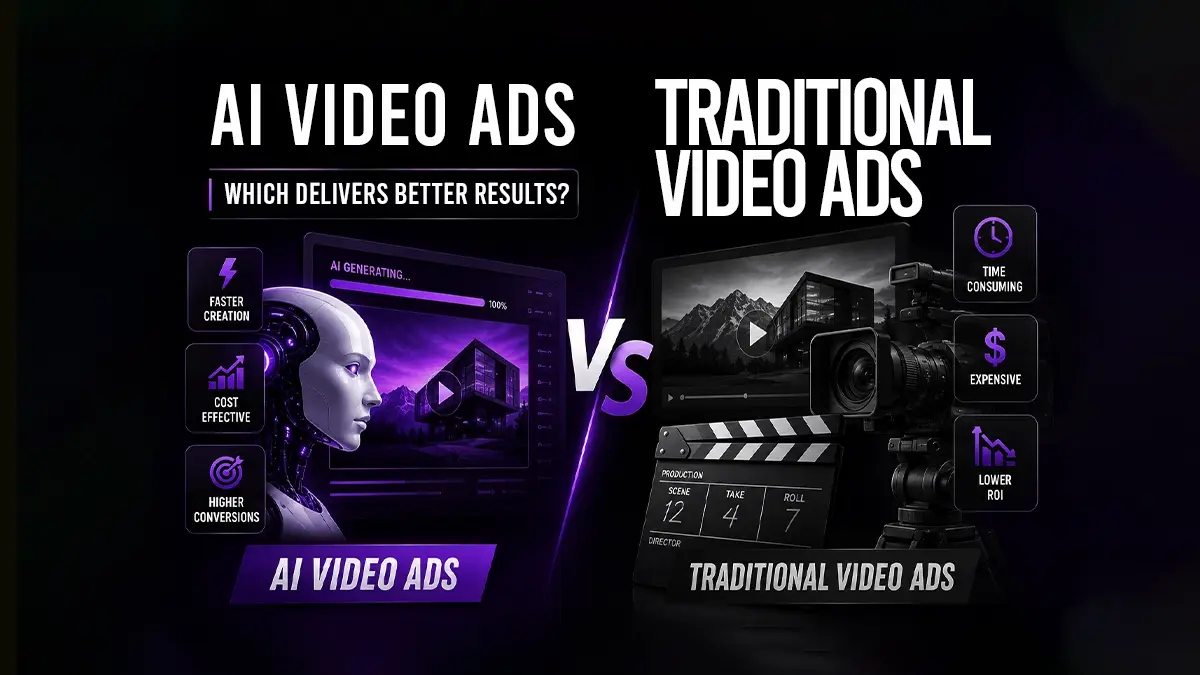
Video Advertising is growing more than ever. This is primarily due to the surge in short-form videos and mobile-first behaviour. The power to create an impact and the unmatched engagement it generates is what makes videos one of the most preferred forms of advertisement.
Traditionally, video ads required large production crews, expensive shoot days, and long editing timelines. Today, brands can create product demos, social media ads, UGC-style videos, explainer clips, and campaign variations using AI-powered tools.
This emergence of AI video ads does not necessarily wave off the need for traditional video ads. They both have their own set of audiences, and each delivers different results. For most businesses, the best approach is not to choose one forever. It is knowing when to use AI, when to use traditional production, and when to combine both. This article is here to guide you with this exact pain point.
What Are AI Video Ads?
AI video ads are promotional videos created or enhanced using artificial intelligence tools. These may include AI-generated scripts, AI avatars, synthetic voiceovers, automated editing, product scene generation, text-to-video visuals, motion graphics, and rapid creative variations for different platforms.
Instead of organizing a full shoot, a business can produce multiple ad concepts using existing product assets, brand guidelines, prompts, templates, and human creative direction. This makes AI video ad production especially useful for brands that need content quickly and frequently.
Common use cases include:
Social media ads for TikTok, Instagram, YouTube Shorts, and Meta
UGC-style product videos
Ecommerce product explainers
SaaS feature demos
Retargeting ads
A/B testing different hooks, offers, and calls to action
Seasonal or limited-time promotional campaigns
The biggest benefit of AI-generated video ads is speed. A brand can test five different opening hooks, three product angles, and multiple voiceover styles without planning a full production cycle every time. For performance marketing teams, that flexibility can directly support better testing and faster learning.
However, AI video ads still need human judgment. Poor prompting, generic visuals, inaccurate product representation, or robotic messaging can weaken trust. This is where a professional team offering AI Video Ads Services can help connect AI speed with brand-safe creative execution.
What Are Traditional Video Ads?
Traditional video ads are produced through a more conventional process. This usually includes strategy, scripting, storyboarding, casting, location planning, filming, directing, lighting, sound, post-production, color grading, editing, and final delivery.
This approach gives brands more control over visual quality, performance, emotion, and production value. A traditional video shoot is often the right choice when the campaign depends on real people, real environments, cinematic visuals, product detail, or a premium brand impression.
Traditional video production works best for:
TV commercials
Brand launch films
Founder stories
High-end product campaigns
Corporate videos
Luxury or lifestyle campaigns
Documentary-style storytelling
Cinematic social ads
Campaigns where authenticity and human emotion matter deeply
Traditional video ads usually take more time and cost more, but they can create a stronger emotional connection when the concept requires depth. A good director, editor, cinematographer, and creative team can shape tone, pacing, facial expressions, atmosphere, and story in a way that AI still struggles to fully replicate.
For businesses that already have filmed assets, professional video editing services can also turn raw footage into polished, high-performing ad creatives.
AI Video Ads vs Traditional Video Ads
Both formats can deliver strong results, but they solve different business problems. The comparison below gives a simple view.
Factor | AI Video Ads | Traditional Video Ads |
Cost | Lower production cost, especially for multiple variations | Higher cost due to crew, filming, equipment, locations, and editing |
Production Time | Fast turnaround; useful for quick campaign launches | Longer timelines due to planning, shooting, and post-production |
Scalability | Easy to create multiple ad versions for testing | Harder to scale without additional shoot days or editing time |
Creative Flexibility | Strong for rapid testing, platform-specific edits, and variations | Strong for custom storytelling, emotional direction, and premium visuals |
Best Use Cases | Performance ads, ecommerce, SaaS demos, social media, retargeting | Brand films, TV commercials, cinematic campaigns, founder videos |
A simple way to decide is this:
Business Goal | Better Option |
Launch paid ads quickly | AI video ads |
Test multiple hooks and offers | AI video ads |
Create a premium brand campaign | Traditional video production |
Tell an emotional founder story | Traditional video production |
Produce frequent social content | AI video ads |
Build a major brand launch asset | Traditional video production |
Reduce cost while increasing ad output | AI + human hybrid |
Repurpose existing shoot footage into more ads | Hybrid production |
The real difference is not only “AI vs human.” It is production economics. AI helps you create more versions faster. Traditional production helps you create deeper, more polished creative assets. A hybrid model gives you the strategic advantage of both.
When Should You Choose AI Video Ads?
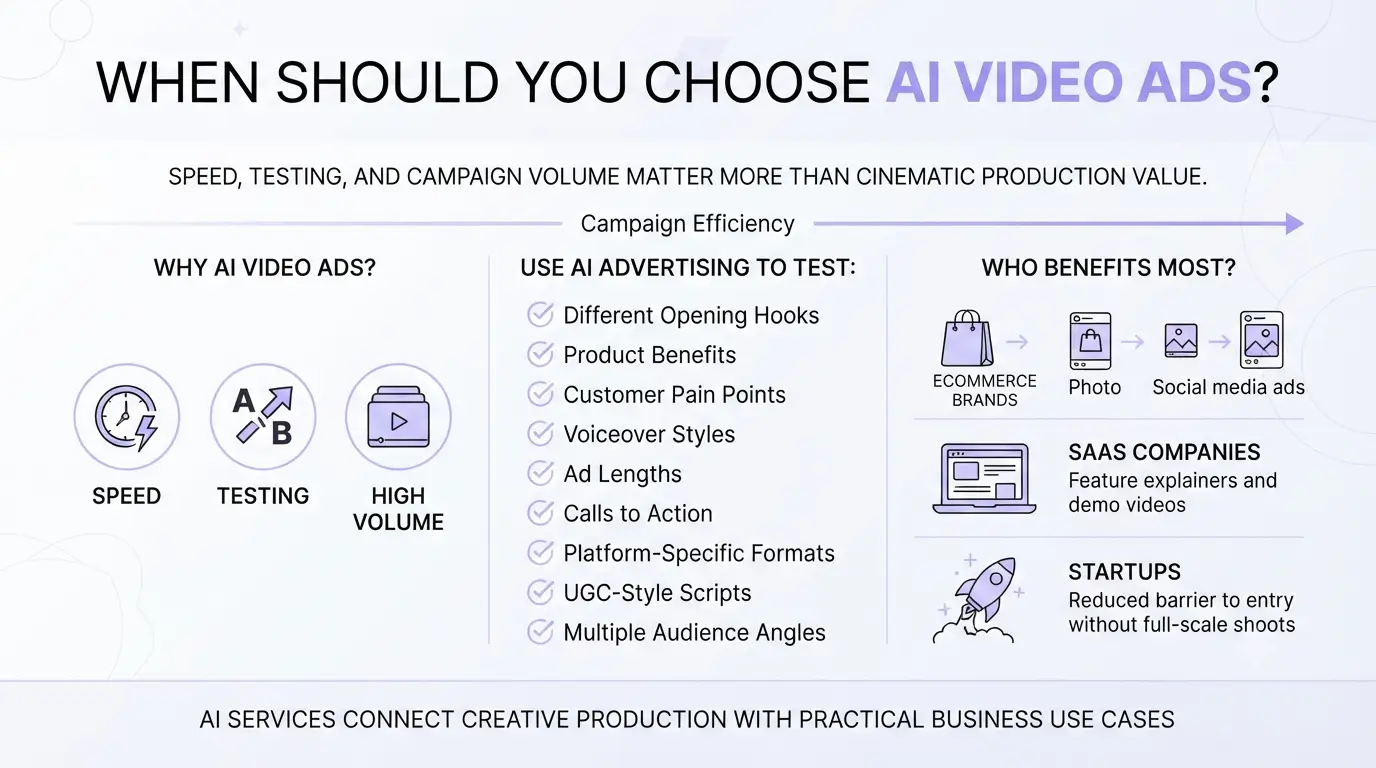 You should choose AI video ads when speed, testing, and campaign volume matter more than cinematic production value.
For performance marketing, creative testing is critical. One ad rarely works forever. Platforms need fresh creatives, audiences respond differently to different hooks, and ecommerce brands often need new videos for offers, product launches, bundles, and seasonal campaigns.
AI advertising is especially useful when you need to test:
Different opening hooks
Product benefits
Customer pain points
Voiceover styles
Ad lengths
Calls to action
Platform-specific formats
UGC-style scripts
Multiple audience angles
For ecommerce brands, AI video ads can help turn product photos, reviews, benefits, and offers into fast social ads. For SaaS companies, AI can support feature explainers, onboarding ads, comparison videos, and demo-style creatives. For startups, AI can reduce the barrier to entry by allowing them to launch video campaigns without committing to a full-scale shoot.
For brands building AI-powered campaigns, AI Services can help connect creative production with practical business use cases.
When Traditional Video Production Makes More Sense
Traditional video production makes more sense when the campaign needs high trust, emotional depth, or premium visual storytelling.
A luxury brand, enterprise company, healthcare provider, real estate developer, or high-ticket service business may not want its most important brand asset to look generated or templated. In these cases, real locations, real people, controlled lighting, custom cinematography, and careful direction can create a stronger impression.
Traditional production is also the better option for TV commercials, brand films, large product launches, investor videos, recruitment campaigns, and cinematic storytelling. These projects are not just about producing content quickly. They are about building perception.
For example, a SaaS company may use AI-generated video ads for retargeting and feature promotions, but still invest in a traditional brand video for its homepage. An e-commerce brand may use AI for weekly product ads, but rely on a studio shoot for its main campaign visuals. A startup may begin with AI ads to validate messaging, then move into traditional production once it knows which message converts.
This is where Creative Services become important. A strong creative partner can help decide which assets deserve full production and which can be created through AI-assisted workflows.
Final Thoughts
So, AI Video Ads vs Traditional Video Ads - which delivers better results?
AI video ads are better when your business needs speed, scale, testing, and cost-efficient production. Traditional video ads are better when your campaign needs cinematic quality, emotional storytelling, premium brand positioning, or real human presence.
The best results often come from using both. AI can help you move faster, test more ideas, and create more campaign variations. Traditional production can help you build trust, brand value, and memorable storytelling. Together, they create a smarter video advertising system.